Cone and Rosette Mosaic
Cone and Rosette Mosaic
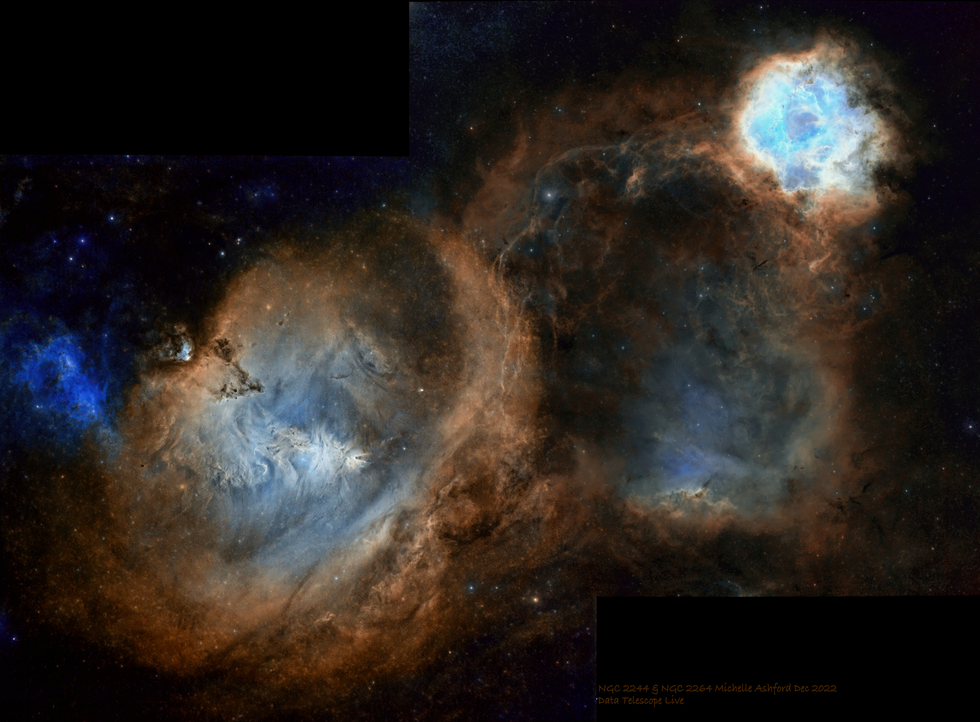
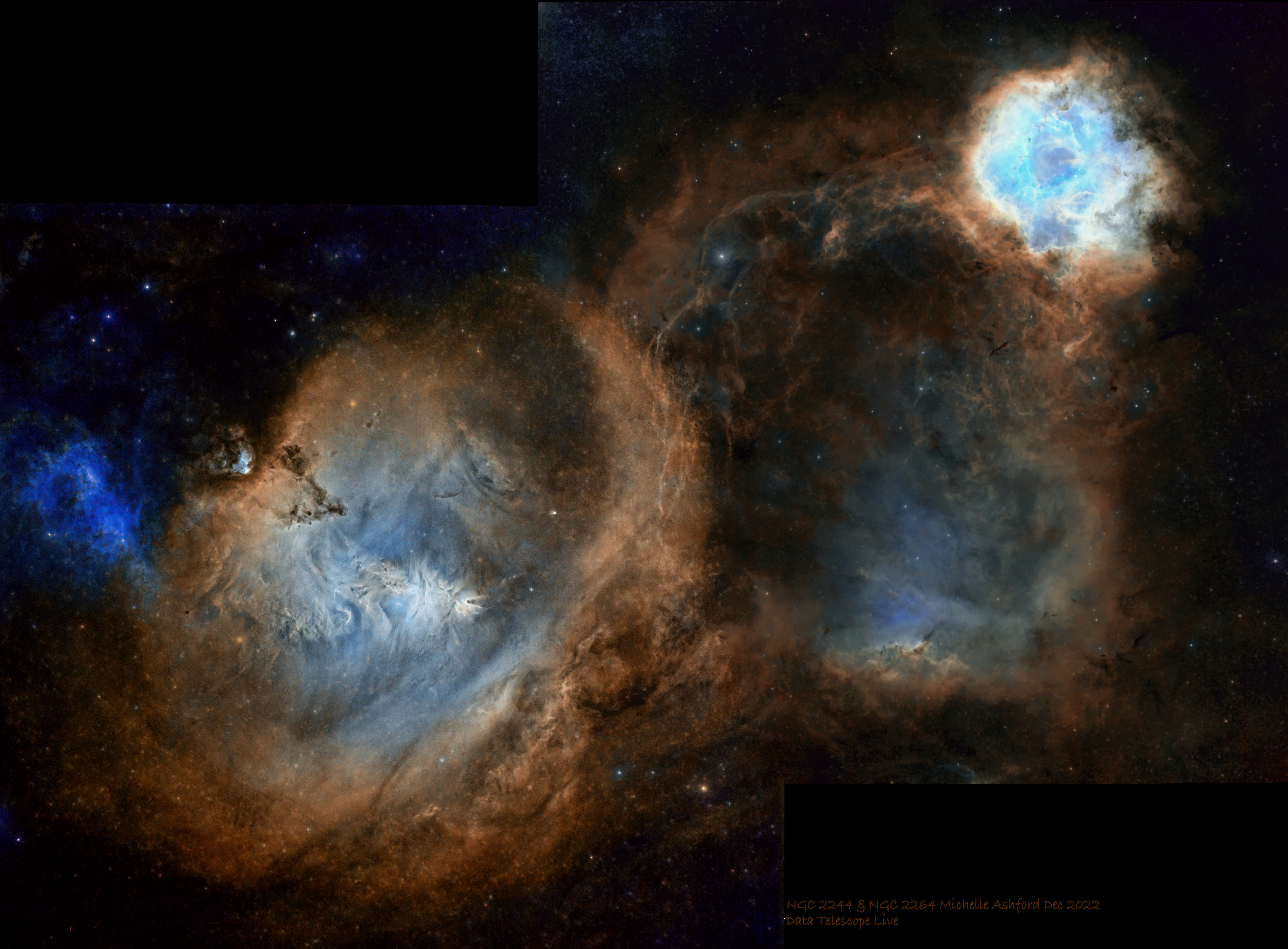
This is a two-panel mosaic of the NGC 2264 and NGC 2237 in the constellation of Monoceros.
NGC 2264 (on the left) lies at an approximate distance of 2,700 ly from Earth in the Orion Arm of the Milky Way. It includes the Cone Nebula, a giant pillar of gas and dust named for its conical shape, which is the result of a dark nebula absorbing the light of an emission nebula that lies behind it. The Christmas Tree Cluster, and the Fox Fur Nebula also share the same NGC 2264 designation.
NGC 2237 (on the right of the image), known as the Rosette Nebula, is an emission nebula spanning a distance of 100 ly and is located 5,000 ly from Earth. At the centre of the nebula is NGC 2244, a group of stars that form a gravitationally bound open cluster thought to be about 4 million years old. These stars are emitting streams of charged particles carving out the gas and dust at the centre of the nebula.
NGC 2264 (on the left) lies at an approximate distance of 2,700 ly from Earth in the Orion Arm of the Milky Way. It includes the Cone Nebula, a giant pillar of gas and dust named for its conical shape, which is the result of a dark nebula absorbing the light of an emission nebula that lies behind it. The Christmas Tree Cluster, and the Fox Fur Nebula also share the same NGC 2264 designation.
NGC 2237 (on the right of the image), known as the Rosette Nebula, is an emission nebula spanning a distance of 100 ly and is located 5,000 ly from Earth. At the centre of the nebula is NGC 2244, a group of stars that form a gravitationally bound open cluster thought to be about 4 million years old. These stars are emitting streams of charged particles carving out the gas and dust at the centre of the nebula.
SPECIFICATIONS
Telescope
SPA-3 Takahashi FSQ-106EDX4
Camera
FLI PL16083
Location
Spain
Date of observation
Total of 21 Datasets between Nov 20 and Nov 22
Filters
SHO
Processing
Affinity, Topaz Labs De-Noise/Sharpen

The world’s largest database of astrophotography data is waiting for you! Start now your free trial
Try it free